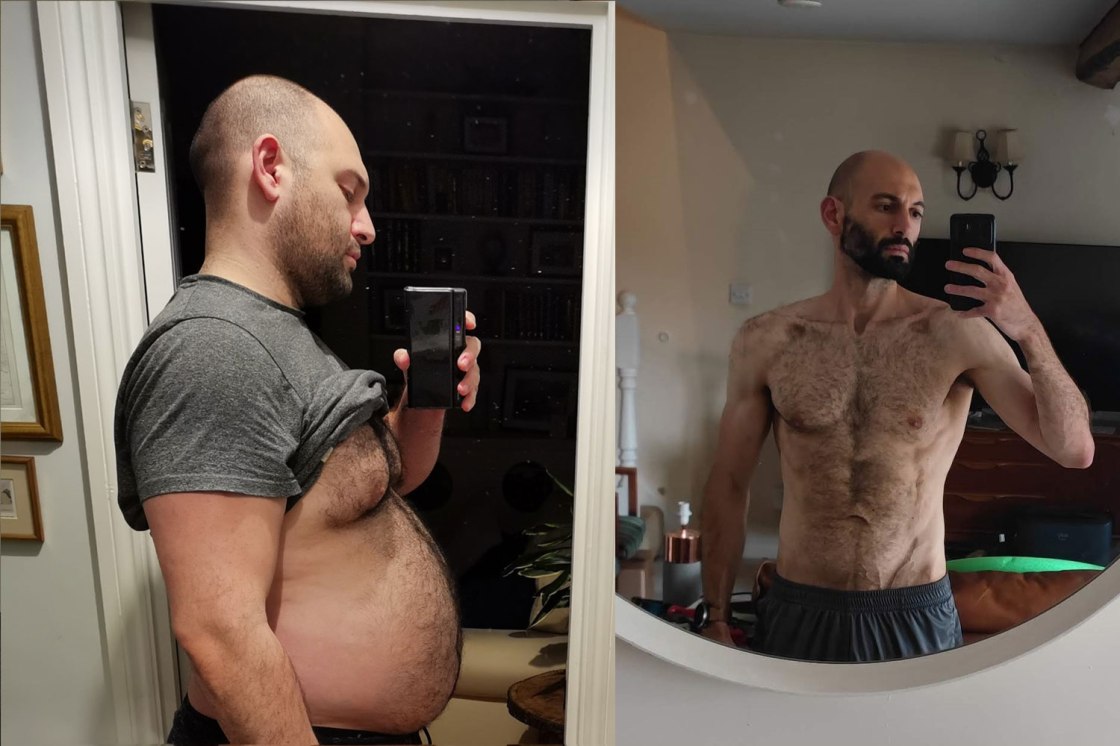
I’ll level with you — I never thought that I’d ever write this article, for two main reasons. Firstly because I had zero conviction that I’d actually ever achieve my goal, and secondly because there are so many emotions and convoluted thoughts involved that I’ve put it off, staring at a blank page on a daily basis, and not really knowing where to start. But let’s give it a shot.
I’ve read so many other people’s accounts of their own journeys over the years and found them inspirational, so if that’s what you take away from this, then that’s great. Hopefully it will also make the incredibly daunting, seemingly impossible task of weight loss appear to be possible. I’ve lived my entire life believing it wasn’t, but the reality is that it’s totally achievable, and really quite straightforward. On paper at least. But it took more than 20 years and countless mistakes for me to reach this point, and while it all seems so obvious now, I know all too well the pain of sacrifice and unhappiness, only to be met with failure after failure, and the vicious circle of guilt, overeating, and, unfortunately, hating yourself for it.
Being unhappy with your own body is not a nice way to live your life. Hating what you see in the mirror, avoiding going out, constantly comparing yourselves to others, feeling like a failure — none of these things are healthy. While I think it’s important to recognise that being overweight is objectively and scientifically a bad thing (with countless proven detrimental health issues), the psychological aspect of all of these negative emotions can be devastating.
Even now, having reached my goal, I’m still coming to terms with how things have changed. And, if I’m being honest, I am still living with the underlying fear that I’ll let things slip again, like so many times before. But this time, for the first time, I truly feel that things are different. More positive. Knowing what I know now, I feel like if I ever let myself go again, it will be a conscious choice, and I’ll know exactly how and why it happened, which is far less terrifying than seemingly going backwards through no control of my own. And more importantly, I’ll know exactly how to fix it. Knowing that offers a level of comfort and reassurance that, until now, was always missing.
With all that said (apologies for rambling), here’s why — and perhaps more interestingly, how — I lost 38kg / 83lbs / 5.9 stone, from November 2023 to July 2024. And if you want to jump straight to the “how” part, click here. I don’t want this to be like a recipe page where I waste 30 minutes of your time before you actually get to the bit you want to read 🙂
Rock bottom
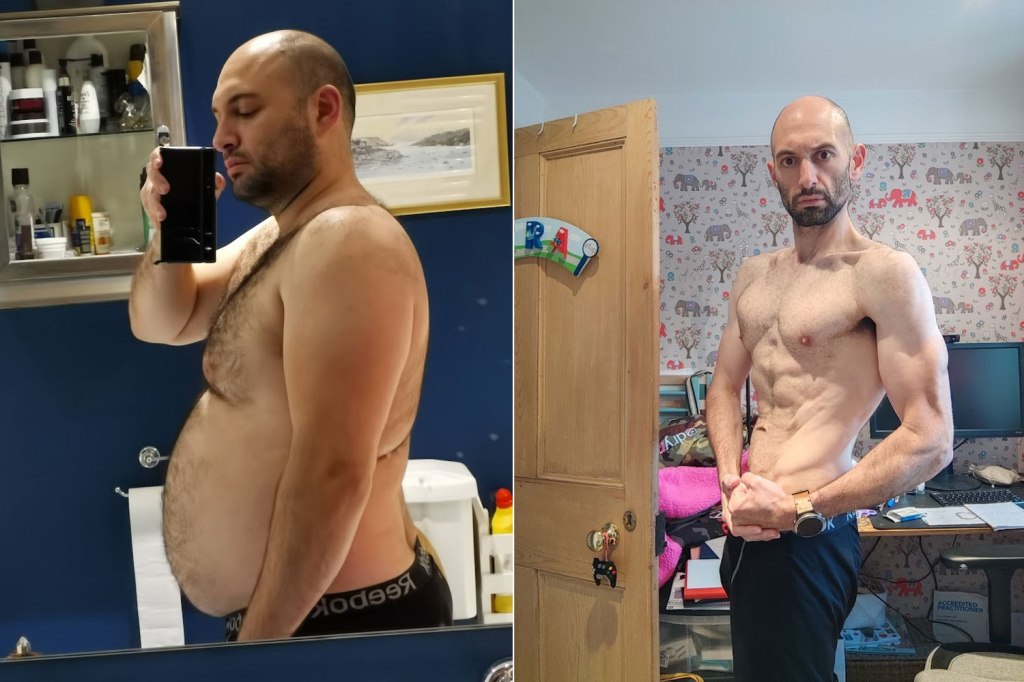
In December 2020, I was the heaviest I’d ever been in my life — 120kg / 265 / 19 stone. I looked and felt awful. I was so uncomfortable in my own skin, daunted by being a new father, and generally feeling very unprepared for life — especially amidst all the horrible things that life threw our way with COVID and lockdowns.
The photo above is from this period. Regardless of what you think, I hated myself for letting things get so bad. I’ve always struggled with my weight, and have, bar a few years here and there with crash diets like keto or intermittent fasting, always been overweight. Technically obese, even. People who know me will (and have) called me crazy for using that term, but the stats don’t lie. I perhaps hide my weight better than some when I’m overweight, given my six-foot height and wide shoulders, but there’s no escaping just how far I’d let things go.
Food was always a huge part of family life for me growing up, and our world revolved around it. Our relationship with it was unhealthy though, and memories of large gatherings where food would be piled up on my plate (because I was “a growing boy”) explain quite a bit about how my relationship with food spiralled out of control as I got older.
If something tasted good, I ate until I was full. Until I was stuffed. And then I just kept going. I could without batting an eye, eat entire multipacks of crisps, biscuits, and sweets at a time, knowing it was bad, but unable to stop. I ate when I was hungry, I ate when I was bored, and it all seemed to spiral out of control. I was obese at school and was, predictably, bullied for it. It wasn’t a great time, as you can imagine.
I got more of a handle on things just before I started working in my early 20s. I actively ate less and began to exercise. By the summer of 2011, I was 74kg, and for the first time in my life, felt happy with my body. But my route to get there was not healthy. I remember going overboard, hitting the stationary bike for at least an hour every day, practically living off cans of tuna and sweetcorn, and barely eating any carbs. I had no idea what I was doing, and lost weight purely through sheer lack of eating and over-exercising. Naturally, there’s no way that was sustainable, and within a few years, I’d eaten my way back up to a heavier weight. Today, I am the same weight as I was back then, but I look far less sickly and malnourished, because I’m actually eating enough to put on muscle, and the fact that I’m not starving myself also means that my current weight is sustainable. But more on that later.
Following my 120kg peak, I spent the next few years trying out various diets. Keto worked multiple times, but I could never sustain it for more than six months at a time. Intermittent fasting too, had some success, but I’ve come to realise that all of these restrictive diets, for me at least, end up leading to failure, because they’re simply too restrictive, and not sustainable. And that’s the real kicker — if you can’t stick to something long-term, you’ll spend your whole life going back and forth, enjoying the short periods of elation, before going through the spiral of disappointment and guilt over and over again.
By the time 1 November 2023 came around, I was 112kg / 247lbs / 17.6 stone. I was miserable. My back hurt. I couldn’t play with my son properly. I felt awful. Tired. Low energy. Lethargic. I generally just felt like I was behind the wheel of a vehicle that was rusting away, and falling apart. I’m not sure what clicked this time around, but I decided that I wanted to do this properly, once and for all. And I finally found a method that worked. It’s one that I knew about, but had put off for the longest time, instead choosing to go down the fad diet route, looking for a quick, easy fix. To cut to the chase — it’s calorie counting. Simply eating less. That’s all it boils down to, which I know disappoints most people when they want to know the secret. But it’s the plain boring truth.
By eating the correct amount for my height and size, rather than the over-eating I’ve been doing my whole life, I’ve essentially recalibrated myself so that I eat the correct amount of food for my body, so that I’m neither hungry all the time, nor full. For people who manage to stay more or less the same weight consistently without ever having to think about it, this is what you’ve naturally been doing without even realising.
Some of us, unfortunately, struggle with this more than others, due to a mixture of genetic and environmental reasons. I’ve already mentioned how my upbringing hasn’t helped matters, but having used FitnessGenes to have a look into my genetics, I’ve also got quite a few genetic markers that unfortunately predispose me to overeat, while gaining fat (and, at least, also muscle) more easily than the average person to boot. But those factors aside, it’s still very possible to take and maintain control, if you’re willing to give it a go.
Eat less, move more
Before I spam you with paragraphs of probably quite boring text, you can skip it all and just watch Renaissance Periodization’s series of fat loss videos on Youtube. I’ve embedded the first one above. I cannot overstate how much these videos have changed my life. Dr. Mike explains everything far better than I ever could, and he seriously knows his stuff. If there’s one thing you should take away from all of my rambling, it should be for you to watch his video series on how to lose fat. I will note though that the only piece of his advice I ignored was taking a break after 12 weeks. I didn’t want to lose momentum, so I carried on going through from November to July — far longer than the recommended amount — and I don’t condone it. Everyone is different, so if you are going to try this, see how it goes. If the hunger and cravings get too much (they did for me during the last few weeks), then it’s okay to take a break, add the 500 calories back in, and just cruise without changing for a while.
If for some reason you want my convoluted explanation though instead of watching the video above — eat less, move more. That’s literally all this really boils down to. It seems obvious, but it’s not an answer most people (including myself) want to hear, because it’s boring, and doesn’t offer the quick and easy fix we’re after. It also suggests that we’re eating too much and not exercising enough, which, if you’re overweight, is the unfortunate truth — but a truth that’s hard to swallow, because it puts the blame solely on us.
There are people who say that calorie counting is a myth, but the countless research, not to mention the very laws of physics, prove otherwise. If you eat more calories than you burn every day, you’ll gain fat. If you eat less calories than you burn every day, you’ll lose fat. If you eat the same calories as you burn, you’ll stay the same weight. It really is that simple. In fact, you can even go further with specific numbers:
A pound of fat is 3,500 calories. So if you eat 500 calories less a day than you burn, you’ll be -3,500 calories after seven days. Congratulations — you’ve just lost one pound in one week. There’s no arguing or finessing your way around this, which is why it works. If you’re not losing weight, it means you’re still eating too much. You can’t use things like slow metabolism or genetic excuses as a shield, as much as you might want to. I’ve used those excuses my whole life, but the reality is that if you eat at a calorie deficit, you will lose weight. The numbers and science simply cannot lie.
As for where to start, there are a few methods. I used this calculator to work out how many calories my body burns every day. It first provides your Basal Metabolic Rate, which is, in essence, how many calories your body needs to simply function. You could be in a coma, and your body will still be burning calories to keep your organs working etc. This is your baseline.
Then you have your TDEE (Total Daily Energy Expenditure) — this is your BMR, plus the extra calories you burn on top of that. These extra calories can be anything from intentional exercise like running or lifting weights, to the non-intentional stuff that actually adds up and can make a big difference. This non-intentional stuff is referred to as NEAT (Non-Exercise Activity Thermogenesis), and includes all the little extras like walking around, doing chores, fidgeting, etc.
Your TDEE is therefore your starting point. Whatever your TDEE value, you cut 500 from it, and that’s how many calories you’ll aim to eat a day. This would have been an impossible task for me without an app, and a set of kitchen scales. I use the Nutracheck app, which was around £20 for a year, and it is, without exaggeration, the best thing I’ve ever spent my money on. It’s easy to use, scans thousands of barcodes, and massively reduces the hassle and stress of calorie counting.
I understand that asking people to weigh their food throughout the day seems like a massive, inconvenient leap, and I’ll admit, it’s the sole reason I tried everything but calorie counting for all these years, because the thought of tracking my food was incredibly overwhelming. But there’s no other way, and the wake-up call alone is worth it.
Within a few days, I realised just how much I was overeating before. I realised that one meal of homemade chilli alone, with my eyeballed portion sizes, could easily be 1,500 calories. If you’ve got 2,400 calories max to eat a day, you can soon see just how easy it is to overeat. A splash of olive oil when frying onions alone can be a few hundred calories — half the 500-calorie deficit you’re trying to aim for.
There’s no two ways about it — if you want guaranteed, unarguable success at losing weight, you need the app, and you need the scales. It’s daunting at first, but it genuinely becomes second nature by the end of the first week. In fact, there’s something rather reassuring about knowing that if you stick to the numbers, you’re guaranteed to lose weight. If you’ve spent your whole life going by guesswork, this is a genuine revelation.
Now, there are a few fluctuations here and there. I remember losing something crazy like a couple of kilograms in the first week alone, which was purely due to losing the initial water weight. But in general, sticking to the plan, and recalculating the numbers above every 5kg lost or so (the less you weigh, the less calories you need), kept me on track.
Patience is key
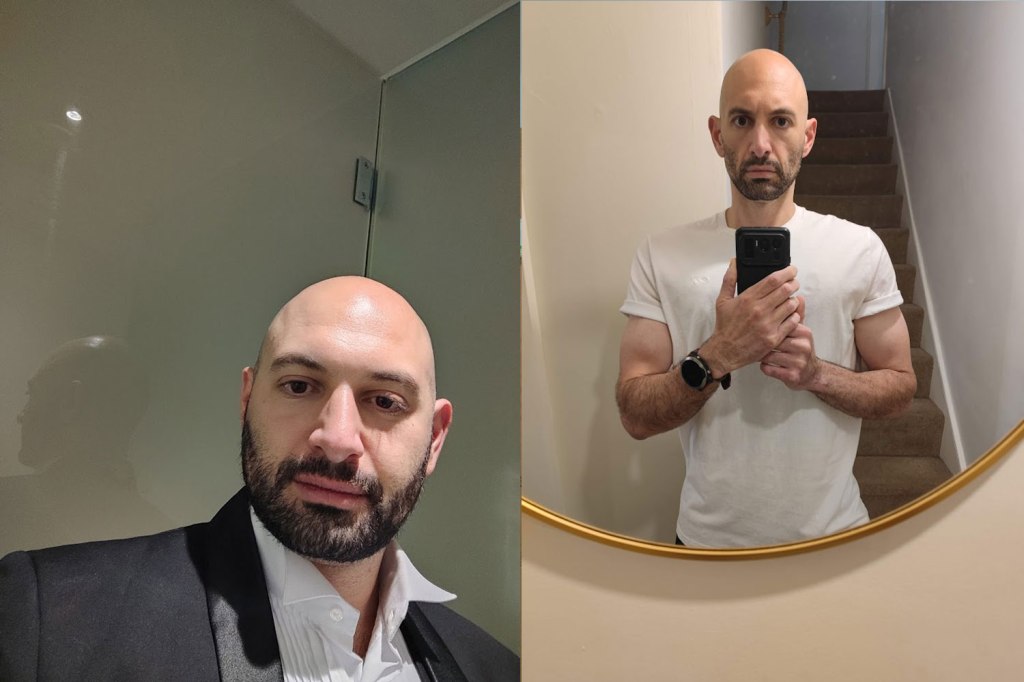
If there’s one main takeaway from my experience, it’s being patient. All my life, I’ve been impatient, wanting instant results. But this time around, I shifted my mindset.I know that this is a process that would be measured in months, not weeks. Hell, with the 3,500 calories per pound of fat rule from above, you can actually work out how long you’ll need at a 500 calorie daily deficit to reach your goal. And yes, the answer is depressingly far away if you have as much weight to lose as I did, but that grounding in reality is also a blessing, as it hammers home that this is a marathon, not a sprint.
Secondly, is consistency. I realised that I wanted to stick to the plan 99% of the time, no matter what. Going by the rules above, you could have -500 calories Monday to Thursday, but one late-night pizza on Friday night could wipe out all the work you put in earlier that week, making the whole process depressingly pointless. Don’t get me wrong, I had days here and there where I still tracked, knowing that I was going well above my limit. I did decide to start this process, rather stupidly, in November, carrying on through Christmas, after all. But whereas before my one or two days off-plan would turn into weeks, months, and even years of being off track, this time around, I made sure that the very next day, when the fun was over, I was back on track, no matter what.
Perhaps more importantly, I didn’t beat myself up as much as I did before. I allowed myself to let loose over Christmas, and tried not to feel too guilty about it. As soon as the guilt starts creeping in, everything crumbles. You think “what’s the point?” and fall off the wagon completely. Instead, saying you’ve been good, and allowing yourself to relax on special occasions, builds up a much more healthy relationship with food, which is what “normal” people do without even realising.
Eat all the things (especially protein)
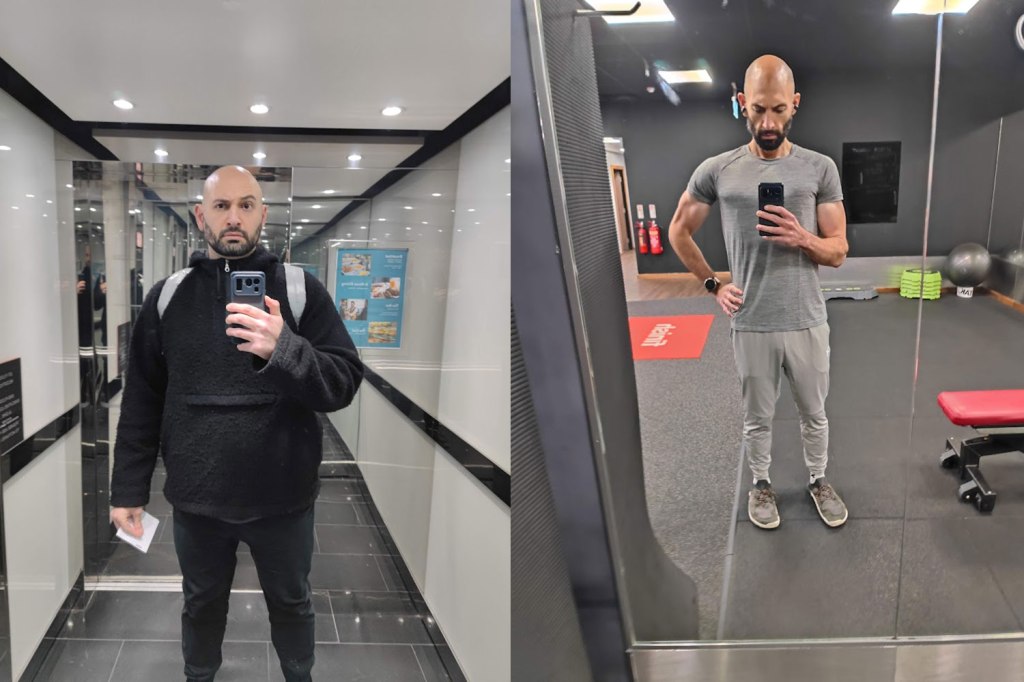
Another key part of my journey, was that I didn’t want to restrict myself from anything. Keto, for example, was fun at first (eat all the bacon and bunless burgers you like!), but carbs are delicious, and we need them. We need fat, protein, and sugar too, despite all the demonisations that a lot of them get.
With this in mind, I’ve genuinely lost all this weight while eating junk food every single day. Don’t get me wrong, I’m mostly eating clean, homemade food, and I’m making sure to get at least my five a day, if not more, but that also doesn’t stop me from having ice cream and popcorn almost every single night, not to mention crisps and more. As long as I hit my five a day and my protein goals (and as long as I don’t go over my daily calorie limit), anything else is fair game.
Not depriving myself of junk food or even alcohol has been game-changing, and has been a massive part of the long-term success of this whole endeavor. I’ve never once really felt like I was depriving myself or missing out, which let me remain consistent over time, without falling off. If you want to see what a typical day of eating currently looks like, here’s what I ate yesterday. I can share some examples from back when I was on my cut as well if that’s useful, just let me know.
Another crucial factor, is to make sure you eat enough protein. To cut a long story short, it fills you up, and makes sure you keep as much muscle on you as possible during your weight loss journey. Work out your body weight in pounds, multiply it by 0.82, and that is more protein than you will need, even if you work out and lift weights six days a week.
Keeping it off
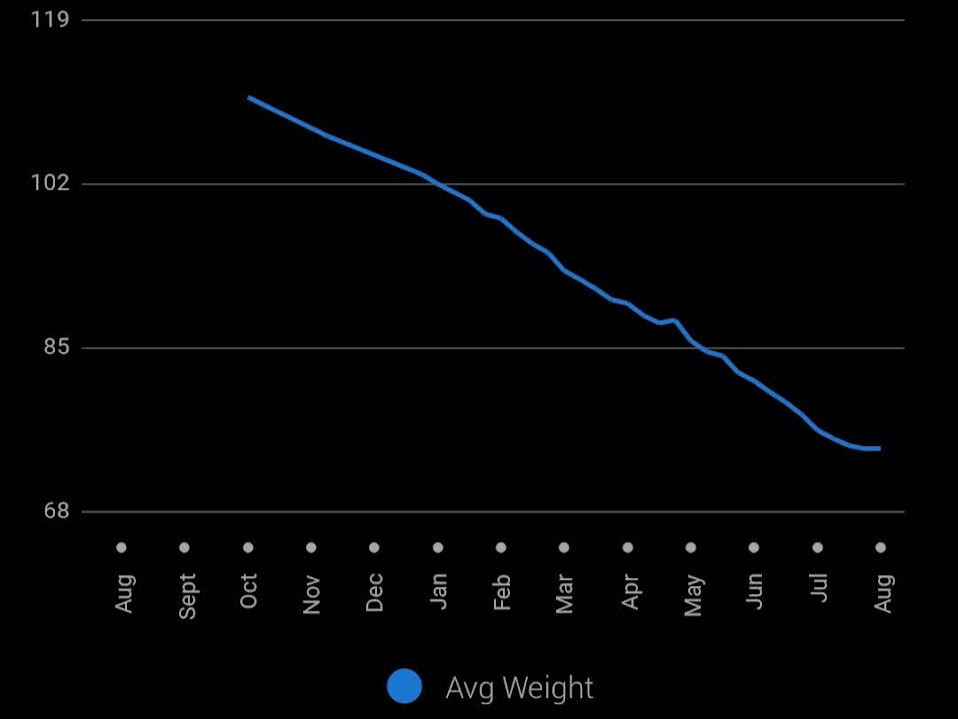
I reached my goal weight of around 75kg in July, and have, one month on, more or less stayed the same weight. I’m currently on maintenance, which means I’ve added back the 500 calories I took out during my diet. In fact, since I started going to the gym and actively trying to walk at least 10,000 steps a day, I’m currently eating 1,000 calories more a day, while remaining the same weight. Without boring you with too many numbers, by the end of my diet I was on 1,750 calories a day (which was getting tough in the hunger department), and I’m currently on 2,750. I might even add another 250 on top of that and see if anything changes, because the weight training and walking might be burning that little bit extra.
My relationship with food has changed too, for the better. I’m not obsessed with it like I was before, and I’m not mindlessly shovelling things in my mouth for the sake of it. I still love eating good food, and really enjoy cooking, but it’s all more considered. I take the time to enjoy it all, and really savour it. I’m still weighing everything as I’m not great at eyeballing amounts yet, but over time, I’ll ditch the scales and see if I can do this on autopilot.
Looking ahead, I’m planning to try my first ever bulk over the winter, which will involve eating slightly over my daily calories so that I put on some fat (and hopefully mostly muscle), before cycling through another fat-loss diet and maintenance again. None of it seems daunting now. It’s just a case of putting your faith in the numbers.
Overall, having reached my goal, I’m proud of what I’ve achieved, and it still seems surreal. I have to say though, that it hasn’t magically cured everything. Getting the six-pack I’ve chased after my whole life hasn’t been the revolutionary moment I thought it would. Instead, I’m just comfortable in my own body, and feel like I can breathe and move freely. I have more energy to play with my son, and am more comfortable just living my daily life. For those reasons alone, the journey has been worth it, and I’m looking forward to seeing where it takes me next.
There’s a million other things that I could write, but I’ve definitely rambled on for too long. I don’t know who will read this, but if you have any questions I’ll be more than happy to answer them.

